A Coach Jacky Story
101 Out of 125
My KCSE story of redirection, learning, and becoming — the story behind Before Your Next Certification…
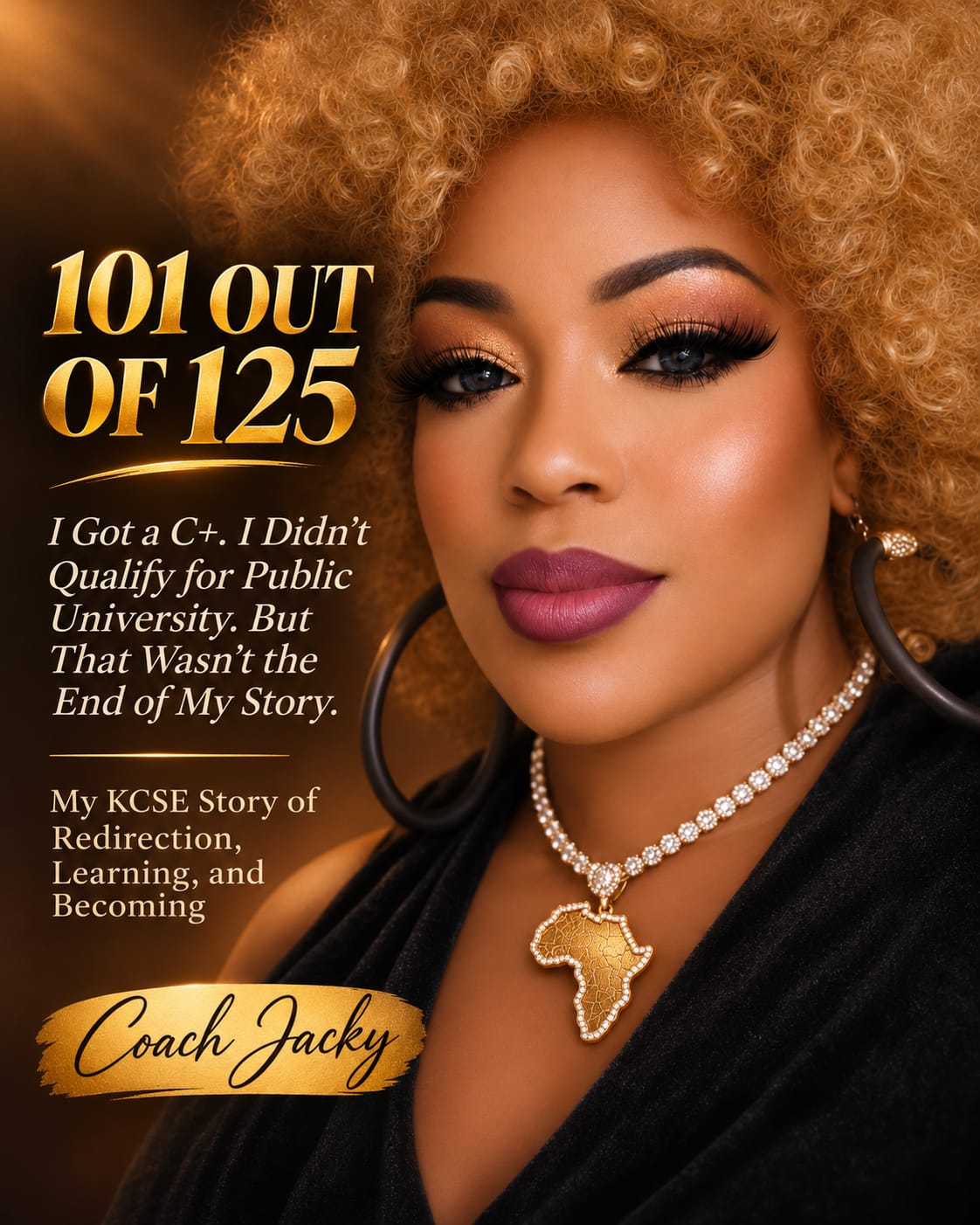
MY KCSE INDEX NUMBER WAS 101 OUT OF 125. I GOT A C+. I DIDN'T QUALIFY FOR PUBLIC UNIVERSITY. BUT HERE'S WHAT THOSE NUMBERS COULDN'T TELL YOU ABOUT ME.
101 out of 125.
Let that sink in.
That was my KCSE examination index number.
In the Kenyan secondary-school system I went through, we sat an examination that helped determine our index numbers for the national examinations.
Mine was 101 out of 125 candidates.
And when I eventually sat my Kenya Certificate of Secondary Education (KCSE) examinations, I earned a C+.
I didn't make the cut for public university.
Now, I could tell this story from the comfortable position of looking back at everything that eventually worked out.
But that would miss something important.
Because when you're young, an academic result can feel like more than a result.
It can feel like a statement about who you are.
About how intelligent you are.
About what you deserve.
About which rooms you will be allowed to enter.
And sometimes, without realizing it, we begin carrying those judgments long after the examination is over.
I know what it feels like to wonder whether you're smart enough.
But before we get into all that, let me take you back to FORM ONE in Kenya.
Because, my people, WHAT AN EXPERIENCE! 😂
FROM PRIMARY SCHOOL TO AN ALL-GIRLS BOARDING SCHOOL
First of all, I was a child who LOVED to play.
Primary school had its challenges, of course, but there was time to laugh, run around, and enjoy childhood.
Then came secondary school.
An all-girls boarding school.
And apparently, overnight, we were all expected to become LADIES.
Ladies walked properly.
Ladies behaved appropriately.
Ladies carried themselves with dignity.
Excuse me?
WHERE DO PEOPLE PLAY AROUND HERE? 😂
Mimi nilikuwa bado mtoto wa kucheza!
(I was still a child who wanted to play!)
Now I'm supposed to be a sophisticated young lady, wake up early, follow strict schedules, manage boarding-school life, and perform academically.
All at once!
There was no transition program for my nervous system.
No emotional onboarding.
Just WELCOME TO SECONDARY SCHOOL!
And before I could fully process the culture shock, the academic curriculum came looking for me.
BIOLOGY: EXCUSE ME, WHO INVITED THE ENTIRE ANIMAL KINGDOM? 😂
In primary school, we had Science and Agriculture.
Then we arrived in Form One, and Science had apparently undergone a corporate restructuring.
Suddenly, it had THREE DEPARTMENTS!
Biology.
Chemistry.
Physics.
And each department had its own textbook, teacher, examination, and expectations.
ATI NINI?
Let us begin with Biology.
We started learning about living organisms and classification.
KINGDOM.
PHYLUM.
CLASS.
ORDER.
FAMILY.
GENUS.
SPECIES.
Animalia!
Annelida!
Oligochaeta!
Polychaeta!
EXCUSE ME, WHO ARE THESE PEOPLE? 😂😂😂
We had barely settled into boarding school, and somebody wanted us to understand the classification of earthworms!
Earthworms!
An animal that had never introduced itself to me was suddenly occupying valuable space in my academic life.
What was the relationship between Oligochaeta and Polychaeta?
Why did I need to know?
Were they fighting over family property?
Was somebody contesting an inheritance?
WHY WERE WE INVOLVED IN THEIR FAMILY BUSINESS? 😂
And you couldn't just laugh and move on.
You had to STUDY.
Understand it.
Remember it.
Explain it.
And reproduce the information under examination conditions.
Then Chemistry arrived.
ATOMS!
ELEMENTS!
VALENCY!
THE PERIODIC TABLE!
MOLES!
Not the animals, mind you.
Chemical moles.
Now we're dealing with Avogadro's number.
6.02 × 10²³.
SIX POINT ZERO TWO TIMES TEN TO THE POWER OF TWENTY-THREE!
Baby, I was struggling to count the days until school closed, and now somebody wanted me to count particles I couldn't even SEE!
WUEEEH! 😂
And then Physics.
Now, Physics was one of my favorites.
I genuinely enjoyed it.
Motion, energy, electricity, forces, and understanding how things work fascinated me.
But let us not confuse enjoyment with ease.
Those calculations could humble you!
And then came MATHEMATICS.
MATHEMATICS PAPER TWO AND THE LEGENDARY FOUR-FIGURE TABLES
My fellow Kenyans, do you remember those mathematical tables?
The FOUR-FIGURE MATHEMATICAL TABLES!
Before calculators became part of ordinary examination life, that little book was practically your academic business partner.
Logarithms.
Antilogarithms.
Trigonometric functions.
You would locate a number, follow the row, check the column, look for the mean difference, and pray that somewhere in the process you hadn't shifted a decimal point.
Because one wrong move?
Your answer had relocated to another continent! 😂
Mathematics Paper Two was something else.
And Chemistry Paper Two?
Biology?
The practical examinations?
The invigilators walking around while you're looking at a question and silently negotiating with God?
Bwana Yesu, hii tulisoma lini?
(Lord Jesus, when did we study this?)
Sometimes I would walk out of an examination thinking:
Well.
I have written something.
Whether the examiner and I were discussing the same subject remains to be established. 😂
But we weren't finished!
Because these were only SOME of the subjects.
HISTORY, GEOGRAPHY, SOCIAL ETHICS, KISWAHILI... AND FASIHI!
My goodness.
We were studying EVERYTHING.
History.
Geography.
Social Ethics and Education.
Mathematics.
English.
Kiswahili.
Biology.
Chemistry.
Physics.
And practical subjects.
I remember Agriculture being part of that broader academic experience.
Eventually, as we progressed through school, we were able to narrow down our subject choices.
But before then?
WE WERE CARRYING THE ENTIRE EDUCATION SYSTEM ON OUR BACKS! 😂
History alone was a whole undertaking.
Dates.
Events.
Colonial administration.
Political movements.
World history.
African history.
You were expected to remember what people had done generations before you were born, sometimes down to the year!
Geography?
Rocks.
Rivers.
Climate.
Landforms.
Weather systems.
We were studying the entire planet while sitting in boarding school!
Then came Kiswahili.
Now, learning Kiswahili was one thing.
But FASIHI YA KISWAHILI?
BABA YANGU! 😭😂
The literature portion!
Novels.
Plays.
Poetry.
Themes.
Characters.
Symbolism.
Language.
Literary interpretation.
You would read a passage and struggle to understand what was happening.
Then the examiner would ask:
Eleza dhamira kuu zinazojitokeza katika kifungu hiki.
(Explain the main themes emerging from this passage.)
EXCUSE ME?
I was still trying to understand what the character had said!
Now you want me to investigate their motivations?
Their emotional state?
Their relationship with society?
The author's deeper message?
KWANI MIMI NI DETECTIVE? 😂😂😂
Honestly, Fasihi had me BUSY.
I would read, reread, and reread again.
And sometimes, the more I read, the more confused I became.
It felt like I was trying to decode ancient Greek!
But here's something I've come to appreciate much later in life.
I was being exposed to complexity before I necessarily had the confidence or maturity to recognize what that complexity was teaching me.
Not just content.
But how to sit with something difficult.
How to revisit a subject that doesn't make immediate sense.
How to recognize that understanding may require multiple attempts.
And, sometimes, how to accept that you've done your best, even when your best doesn't produce the result you hoped for.
Would I voluntarily sit KCSE again today?
PLEASE!
I have done professional certifications. I work in technology. I'm happily navigating the rapidly changing world of artificial intelligence.
But KCSE again?
HAPANA, ASANTE SANA! 😂
And yet, I wouldn't necessarily change the decision to study all those sciences.
They challenged me.
They stretched me.
Some subjects humbled me.
Others sparked my curiosity.
And although my career eventually took a direction I didn't anticipate, that curiosity never left.
THEN CAME THE KCSE RESULTS.
C+.
Not the grade needed for my intended public university route.
And this is where the laughter gives way to something I want parents, educators, students, professionals, and anyone who has ever felt academically inadequate to consider.
What happens when a measurement of performance becomes a measurement of identity?
Because those are not the same thing.
A grade can tell us something important about academic performance against a particular standard.
It can reveal gaps in knowledge.
It can reflect preparation.
It can influence admission opportunities.
Those things are real.
But it cannot, by itself, tell us everything about a person's capacity to learn, adapt, create, lead, innovate, or contribute to society.
And it certainly cannot predict every possibility that person may encounter over the next forty years.
In my book Before Your Next Certification, I explore this distinction in a chapter titled:
"Rejection Is Data. Your Nervous System May Call It Identity."
Think about that.
You receive a rejection.
You miss an opportunity.
You fail an examination.
You don't qualify.
Those are events.
But sometimes the mind begins writing a much larger story:
I'm not intelligent.
I'm behind.
I'm not good enough.
Other people are better than me.
And before long, an event has become a biography.
That's a dangerous transition.
Because when you start believing a temporary outcome is your permanent identity, you may stop attempting things you are entirely capable of learning.
Now, I also want us to be careful.
Not every struggle is simply a matter of mindset.
Sometimes the material really is difficult.
Sometimes foundational understanding is missing.
Sometimes access to quality education is unequal.
Sometimes a child is dealing with stress, financial circumstances, instability, or learning challenges.
Sometimes the teaching method isn't reaching the student.
Sometimes the student is more interested in another field.
And sometimes, yes, the student simply needs more discipline, preparation, and practice.
We need to investigate before we label.
There's that familiar saying:
Ask a fish to climb a tree, and it may spend its life believing it is stupid.
Now, I don't interpret that to mean we should never challenge a fish to learn something unfamiliar.
I'm saying we should understand what we're measuring before declaring what someone is worth.
Are we comparing apples to apples?
Are we testing knowledge, understanding, speed, memory, or performance under pressure?
Are we looking at the whole student?
Or have we reduced a human being to a number?
Because the consequences of that reduction can travel well beyond the classroom.
A child becomes an adult.
The adult enters the workforce.
And sometimes that old feeling of not being good enough follows them into interviews, leadership opportunities, negotiations, relationships, and career decisions.
The examination may have ended decades earlier.
But the internal examination continues.
AND THEN MY FATHER MADE ANOTHER PATH POSSIBLE.
Because I hadn't qualified for public university, my father made it possible for me to attend a private American university in Africa.
And BABY!
WHAT A DIFFERENT EXPERIENCE! 😂
I studied International Business.
The educational experience felt more focused to me.
More connected to what interested me.
More practical in the way I could engage with it.
And the INTERNATIONAL part?
WE WERE LIVING IT!
Students from Ghana.
Nigeria.
Senegal.
Uganda.
Tanzania.
Egypt.
Kenya.
America.
The United Kingdom.
And beyond.
It was the UNITED NATIONS WITH STUDENT IDENTIFICATION CARDS! 😂
Different accents.
Different cultures.
Different beliefs.
Different perspectives.
Different experiences of the world.
We learned together.
We argued.
We laughed.
We built friendships.
And let us not pretend that college was all about textbooks.
PLEASE!
There was a SOCIAL LIFE! 😂
There were parties.
There were rugby players.
There were handsome young men.
There were friendships, adventures, and the beautiful chaos of discovering adulthood.
And somewhere in that college experience, I met one of my college sweethearts.
An American gentleman who had come to Africa to discover his roots because his father was African.
This man had practically crossed continents to discover WAKANDA! 😂😂😂
And somehow, along the way, he met a Kenyan girl.
NOW THAT...
That is another story entirely!
Would you like to hear about the American gentleman who came looking for Wakanda and found himself a Kenyan college sweetheart? 👀😂
We shall revisit that chapter another day.
Because, my people, there are STORIES!
But back to the education.
That university became one of the most meaningful environments of my life.
The friendships I formed were not limited to Kenya.
My network became international.
There was also a campus in San Diego, extending the global dimensions of that experience.
And decades later, those relationships remain extraordinary.
Some of the people I met continue to be part of my life.
The friendships.
The professional connections.
The opportunities.
The conversations.
The ability to understand people whose lives and experiences are different from mine.
That environment shaped me in ways that went far beyond my degree.
And the remarkable thing is that I entered that environment because I hadn't qualified for the route I originally expected to take.
Now, does that mean failing to qualify for public university was automatically a blessing?
No.
I cannot know what my life would have looked like had I taken that route.
I might have had an equally beautiful experience.
But I do know the opportunities that emerged from the path I actually traveled.
And I am deeply grateful for them.
Sometimes a closed door is simply a closed door. But sometimes another door opens, and what we do with that opportunity changes the direction of our lives.
THE INTERNATIONAL BUSINESS STUDENT WHO FELL IN LOVE WITH TECHNOLOGY
Here's another part of the story.
I didn't study technology in university.
I studied International Business.
And yet today, technology is one of my greatest professional passions.
SAP Security.
Cybersecurity.
Identity and access management.
Enterprise systems.
Cloud technologies.
AI governance.
Artificial intelligence.
And the relationship between technology, business, leadership, risk, and human behavior.
How did that happen?
Through learning.
Through curiosity.
Through professional opportunities.
Through studying.
Through practice.
Through certifications.
And through repeatedly entering rooms where I didn't yet understand everything.
Please don't imagine that my transition into technology was easy.
IT WAS NOT.
There were technical concepts I struggled to grasp.
Things I needed to revisit.
Processes I needed to understand from the ground up.
Moments when I felt overwhelmed by how much there was to learn.
And sometimes, as an adult, that feeling takes you right back to the classroom.
Back to the girl trying to understand Fasihi.
Back to the girl wrestling with Mathematics Paper Two.
Back to the girl wondering whether she was smart enough.
Except now, you have an opportunity to respond differently.
Instead of asking:
What is wrong with me?
You can ask:
What exactly am I not understanding?
What foundational knowledge am I missing?
Is there another way to approach this?
What do I need to practice?
What is the next small step?
And then you return.
Again.
And again.
Until what once felt unfamiliar begins to make sense.
Until what required conscious effort gradually becomes more intuitive.
That is part of what I mean when I talk about a lifestyle of learning.
Not collecting certifications merely to prove that you're intelligent.
Not pursuing education to compensate for some imagined inadequacy.
But remaining curious enough to keep expanding what you're capable of understanding and doing.
And here's something else.
Learning isn't always exciting.
Sometimes it's frustrating.
Sometimes it requires discipline when motivation has completely abandoned the building.
Sometimes you have to read the same paragraph five times!
And sometimes you need to close the laptop, go for a walk, come back, and try again.
That is learning, too.
BEFORE YOUR NEXT CERTIFICATION... ASK YOURSELF SOMETHING.
One of the reasons I wrote Before Your Next Certification was to explore the relationship between knowledge, identity, fear, visibility, and professional growth.
Because I began noticing how often people were acquiring more knowledge while still questioning whether they were enough.
More credentials.
More qualifications.
More training.
And sometimes, still afraid to apply for the opportunity.
Still hesitant to speak.
Still unsure whether they belonged.
But there's a distinction worth making.
Sometimes you genuinely need more knowledge.
You need the technical competence.
You need the qualification.
You need to understand the material.
And sometimes, you already possess valuable knowledge, but something else is preventing you from using it.
Fear.
Uncertainty.
An old identity.
An experience of rejection.
A belief that you must know everything before you can begin.
In the book, I call attention to the Knowledge-Safety Gap.
Because a human being doesn't bring only a résumé into an opportunity.
They bring their history.
Their relationship with authority.
Their memories of rejection.
Their cultural conditioning.
Their experience of belonging.
Their understanding of risk.
And the stories they've learned to tell themselves about what they deserve.
This matters tremendously in the age of artificial intelligence.
AI is changing how we work.
How we learn.
How we solve problems.
How we communicate.
How we create.
And how we define professional value.
But the people who benefit from those possibilities will not necessarily be the ones who already know everything.
Nobody does.
They will include people who can remain curious, adapt thoughtfully, learn new skills, apply judgment, and work effectively with others.
That requires something more than technical knowledge.
It requires a willingness to be a beginner again.
And that can be uncomfortable for an adult who has spent decades building an identity around being competent.
I know.
Because I continue to experience it.
At 49, I remain genuinely excited about studying, technology, artificial intelligence, governance, and all the ways we can use these capabilities to help people.
Children.
Professionals.
Farmers.
Older adults.
Communities that haven't always had access to the same opportunities.
And I'm equally fascinated by the HUMAN part.
What makes somebody curious?
What makes somebody withdraw?
What makes somebody believe they cannot learn?
What helps them try again?
How do we create environments where people feel challenged without being diminished?
Where difficulty is acknowledged without becoming humiliation?
Where excellence matters, but dignity is not conditional upon excellence?
Those are questions worth asking.
BECAUSE THE C+ WAS NEVER THE WHOLE STORY.
It was a real result.
It reflected how I performed.
It affected my university options.
I don't need to deny any of that.
But it didn't determine whether I could eventually learn enterprise security.
It didn't predict my passion for technology.
It didn't describe the international relationships I would build.
It didn't tell me what I would discover about leadership, business, neuroscience, or artificial intelligence.
And it didn't know anything about the books I would eventually write.
That examination measured something. It just didn't measure everything.
And I think we need to remember that when we look at our children.
When we look at our students.
When we consider someone changing careers.
When an older adult wants to return to school.
When a professional is learning an unfamiliar technology.
And when we look at ourselves.
Because sometimes we become our own harshest examiners.
We remember every mistake.
Every rejection.
Every opportunity we didn't get.
And we quietly forget the evidence of everything we've learned since.
In Before Your Next Certification, I write about building an Evidence Bank.
An intentional record of the things you've actually done, learned, attempted, and recovered from.
Not imaginary affirmations.
Evidence.
You tried.
You learned.
You struggled.
You returned.
You improved.
You adapted.
You did something you previously believed you couldn't do.
That matters.
And it is especially important when an old experience tries to convince you that you are still the person you were at your most difficult moment.
SO WHAT WOULD I TELL THAT GIRL, NUMBER 101 OUT OF 125?
I wouldn't tell her that grades don't matter.
I wouldn't tell her that she should stop trying to excel.
And I certainly wouldn't tell her that every setback guarantees some extraordinary future.
Life doesn't work that way.
I would tell her:
Study.
Work hard.
Ask questions.
Take responsibility for what you can improve.
Don't run away from difficult subjects.
But please don't confuse a difficult subject with a defective mind.
Don't confuse a missed opportunity with a life sentence.
And don't allow an examination result to become the final authority on who you are.
Because life is going to introduce you to things you haven't even imagined yet.
Different countries.
Different cultures.
Different people.
Different careers.
Different technologies.
Different versions of yourself.
Some experiences will be wonderful.
Some will humble you.
Some will require you to start again.
And you will discover that being capable doesn't mean everything comes easily.
Sometimes capability is developed precisely because you kept returning to something that was difficult.
And, my goodness, you will learn!
You will laugh.
You will love.
You will make mistakes.
You will have beautiful experiences.
You will discover things that fascinate you.
You will write books.
You will keep studying.
And you will realize that the most important lesson was never that you became better than the people who ranked ahead of you.
They had their journeys.
You had yours.
The lesson is that you were never finished becoming.
AND IF THIS STORY RESONATES WITH YOU...
I explore these questions more deeply in my book, Before Your Next Certification: How Your Nervous System Shapes Visibility, Leadership, Money, Risk and Growth in the AI Age.
It's about the human being behind the qualifications.
The professional who keeps studying but still hesitates to be seen.
The person who mistakes rejection for identity.
The capable individual who struggles to recognize their own value.
And the importance of learning to distinguish between a genuine knowledge gap and an old story about who we believe we are.
Because sometimes the next step really is another certification.
And sometimes, the next step is learning to use the knowledge and capabilities you already possess.
📚 Read Before Your Next Certification by Coach Jacky on Amazon:
https://www.amazon.com/dp/B0HMBNV3KH
LET ME LEAVE YOU WITH THIS.
I started this story with a number.
101 out of 125.
And I want to end it with a question.
What number, grade, rejection, judgment of your ability, or difficult season have you allowed to become a permanent story about yourself?
Who convinced you that you weren't intelligent enough?
Who made you believe that you'd fallen too far behind?
Who told you that your age, your educational background, or your starting point meant you couldn't begin again?
And what evidence have you gathered since then that might challenge that conclusion?
Perhaps the most useful question isn't:
Why wasn't I good enough back then?
Perhaps it's:
What am I capable of learning, building, and becoming from where I stand today?
I'm 49.
Still curious.
Still studying.
Still learning.
Still finding new things that challenge me.
And yes, occasionally still looking at something complicated and saying:
WHAT THE HECK IS THIS? 😂
But I go back.
I investigate.
I learn.
I practice.
And I try again.
Because the objective was never to know everything.
It was to keep developing the capacity, courage, and curiosity to learn.
And to the beautiful people who survived KCSE with me...
Especially my fellow Mathematics Paper Two, Chemistry, Biology, and Fasihi survivors...
BUT DID YOU DIE? 😂😂😂
No, baby.
WE SURVIVED!
And some of us are still recovering from those four-figure mathematical tables!
But more importantly...
We're still becoming.
With love,
Coach Jacky ❤️
Creator of the N.I.T.T.I. Framework™
Name It. Investigate It. Tame It. Transform It. Integrate It.